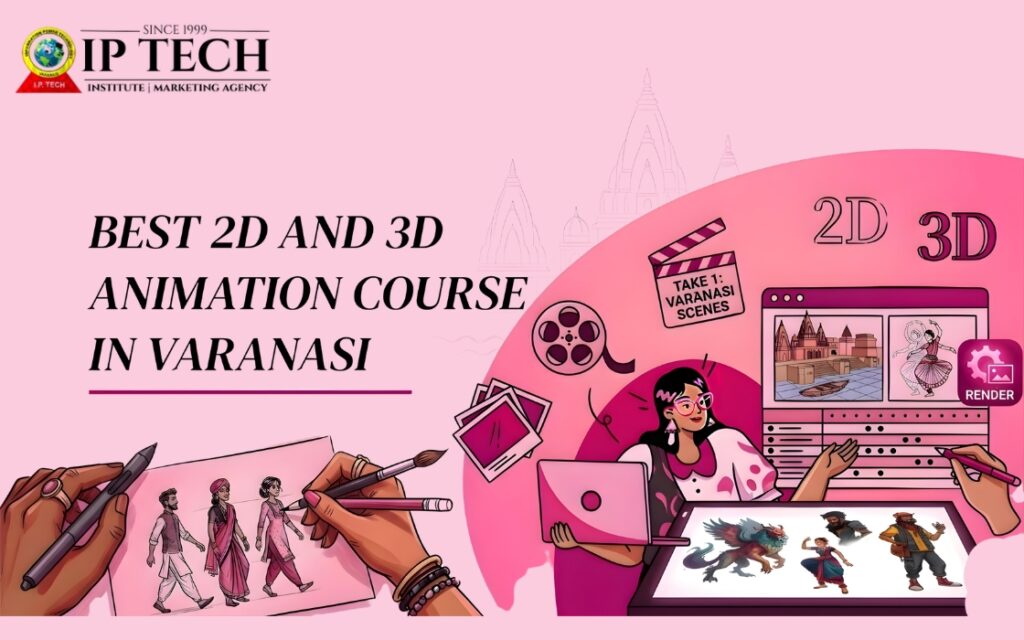
This is the actual, unglamorous starting point of digital art. When you look at those polished advertisements for creative institutes, they never show you the sheer amount of eraser dust—whether physical or digital—that goes into a single moving frame. They don’t show the animator staring blankly at a wall, trying to mentally calculate how a shoulder joint rotates when a character simply reaches for a cup of cold tea.
Surviving the 2D Trap in Your Best 2D and 3D Animation Course in Varanasi
People outside the industry often think 2D is the “easy” stuff because it is flat. That is a massive trap. 2D is a complex game of visual trickery. You are trying to convince the human eye that a completely flat screen has depth, volume, and life.
The Devastating Layer Mistake: Imagine this scenario. You are deeply in the zone. You just spent four hours meticulously drawing a complex action pose. The lines are loose, energetic, and full of that messy human detail that makes art genuinely great. You go to animate the next frame, and your stomach drops. You drew the character on the background layer.
Your beautiful hero is permanently fused to a static drawing of a brick wall. You cannot separate them. You have to scrap it all. It is a painful rite of passage.
The Illusion of Volume: In the best 2D and 3D animation course in Varanasi, you learn that flat artwork doesn’t mean lifeless artwork. You have to draw invisible lines in your head. You have to understand how clothing folds over a moving knee, not just copy an outline. It requires a deep understanding of perspective that makes your brain ache before it finally clicks. What do you think that you want, only the Best 2D and 3D animation in Varanasi, or the somewhat good 2D and 3D animation courses, it’s all your choice, think wisely what suits your need.
The Charm of the Smudge: The absolute best 2D work always has a little bit of dirt left in it. If you clean up your lines too perfectly, the character looks like a lifeless corporate logo. You have to learn how to keep the raw energy of a rough, chaotic sketch alive even in the final, colored version. It is about preserving the human touch in a digital medium.
The 3D Headache Explained in the Best 2D and 3D Animation Course in Varanasi
If 2D is a drawing trick, 3D is a complex mathematical construction site. You are no longer sketching on a canvas; you are building from scratch in a digital void where you have to manually define gravity, light, and matter.
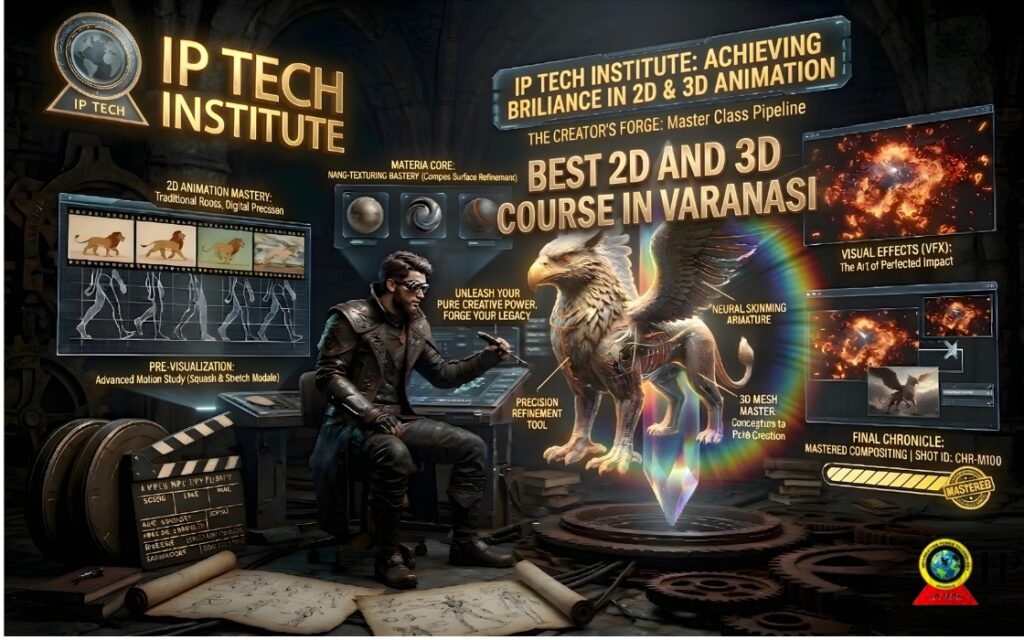
The Heavy Lifting: 3D Headaches in the Best 2D and 3D Animation Course in Varanasi
Wrestling with Digital Clay: You start with a gray, lifeless cube in the middle of an endless grid. You have to push and pull its corners until it starts to resemble a face. It is tedious, exhausting work. Your first few attempts will look terrifying. They will look like melting wax figures. You must have the patience to keep tweaking individual vertices until a recognizable, human shape emerges from the math.
The Nightmare of Topology: This is often the most unglamorous part of any Best 2D and 3D animation course in Varanasi. Topology is the grid of microscopic squares and triangles that make up your model’s skin. If you map it out carelessly, your character will try to smile, and their cheek will collapse inward like a crushed soda can. You have to build the mesh to logically mimic the flow of real human facial muscles.
Rigging the Skeleton: You have a beautifully sculpted model, but it is paralyzed. Rigging means building digital bones and meticulously painting “weights” to tell the software which bone moves which piece of skin. It feels exactly like doing advanced spreadsheet mathematics. If you make a tiny error, simply raising an arm will cause the character’s ribcage to stretch across the screen like melted cheese.
The Lighting Deception: You finally have a moving character, but now you have to light the scene. You put a virtual bulb in the room, and suddenly your cute, cheerful mascot looks like a villain in a horror movie because the shadows are too harsh. You will literally spend hours moving a virtual light bulb two millimeters to the left, hitting render, and waiting, just to get a soft, natural highlight on an eyeball.
The Unsaved File Heartbreak: We have all been there. You are working for hours, completely lost in the process, and suddenly the power flickers or the software quietly closes without a single error message. You haven’t saved for two hours. The feeling of absolute emptiness that washes over you is indescribable. You learn very quickly that hitting “Save” is not an action; it is a nervous tic you perform every three minutes without thinking.
Embracing the Messy Middle: Your first draft of an animation will always look terrible. It will look like robotic, stiff garbage. The great secret taught in a dedicated Best 2D and 3D animation course in Varanasi is that the magic happens entirely in the refinement phase. You have to go back and intentionally add imperfections. A slight hesitation before a jump. A tiny, asynchronous blink. A slight drag of a foot. Those flaws are exactly what make humans look human.
The Rendering Waiting Game: Rendering is the final hurdle. It is when your computer finally processes all your hard work, lighting, and textures into a final video file. It is agonizing. You will sit there watching a progress bar slowly crawl from 1% to 2%, silently praying that the software doesn’t crash at 99%. You become intimately, frustratingly familiar with the loud humming of your computer’s cooling fans.
The Spark of Life: There is a singular, magical moment that makes every single backache and headache worth it. You hit the play button, and the timeline scrubs forward. That cluster of pixels you have been wrestling with suddenly breathes. It shifts its weight. It looks around the digital room. For that one fleeting second, you aren’t looking at math and code; you are looking at a living thing that you pulled into existence.
What Your Desk Will Actually Look Like
Before we even talk about computers and software, let us talk about your physical space and your body. Learning this craft changes your daily habits in very weird, noticeable ways.
The Cluttered Workspace: Your desk will absolutely not be empty. It will be covered in sticky notes with random, panicked reminders like “fix the left knee drop” or “save the file NOW.” You will also probably have a small mirror propped up against a coffee mug. You will use this to make weird, angry, or sad faces at yourself to see how your own eyebrows and cheeks actually move. Anyone walking into your room will think you are acting in a play, but that is the only way to make a face look genuine.
But it is actually a massive test of your patience and your ability to handle silly, human mistakes without throwing your computer.
The Devastating Background Mistake: This will happen to you, and it will hurt your feelings. You will spend four hours drawing a beautiful character. The lines are sketchy, full of energy, and perfectly imperfect. You feel so proud. Then, you try to make the character walk forward, and your stomach drops. You realize you drew the character on the same digital sheet of paper as the background trees.
You cannot separate them. You will draw a line, hate how it looks, hit the “undo” button instantly, and draw it again. You will do this fifty times for a single strand of hair falling across a forehead. It is a messy process of guessing, failing slightly, and trying again until your tired eyes tell you it looks okay.
Keeping the Wobbly Lines: If you make your drawing too clean and perfect, it looks fake. It looks like a factory machine printed it. You have to learn to leave a little bit of a wobble in your lines. A slight mistake in coloring outside the lines makes the character feel warm, reminding the viewer that a real person with shaky hands made it.
The Heavy Lifting: 3D Headaches in the Best 2D and 3D Animation Course in Varanasi
When you move into 3D work, you stop drawing and start acting like a digital sculptor who is also trying to solve complicated math problems. It is an entirely different kind of headache.
This is incredibly tedious work. You have to tell the computer, “This bone only moves the upper arm.” If you click the wrong setting, your character will try to point at the sky, and their entire stomach will stretch upwards like chewing gum. You will spend hours untangling these invisible strings just so your character can stand still naturally.
The Spark of Life: Embracing the Messy Middle
Waiting for the Lights to Turn On: You place a digital light bulb in your scene to make it look nice and moody. But you cannot see it instantly. You press a button, your computer fans start humming loudly, and you wait. You stare at a little loading bar for five minutes. When the picture finally appears, you realize the light is too bright and makes your character look sweaty and tired. You move the light a tiny bit to the left, and you sit back and wait all over again.
The Involuntary Save Habit: The local power grid will become your strictest, most unforgiving teacher. A sudden power cut during a warm summer afternoon will wipe out three hours of your hard work. After that happens exactly once, you will develop a nervous twitch where you hit the “save” button every two minutes, even if you just moved a single line by one millimeter.
The Quiet Bubble: The outside world is loud with traffic, voices, and daily life. Putting on your headphones and staring at your timeline becomes a strange, quiet hiding place. You take all that busy, vibrant energy from the streets and force it down into the tiny, deeply focused movement of a digital hand waving hello.
The First Breath: You spend days pushing points around, untangling strings, and fighting with the software. Then, you finally hit play. The timeline moves forward. That collection of flat lines or gray 3D shapes actually shifts its weight, blinks its eyes, and looks around the screen.
-
Best 2d and 3d animation courses in Varanasi often start with a cluttered desk covered in graphite smudges and half-erased character sketches.
-
Best 2d and 3d animation course in Varanasi won’t just teach you software; they’ll show you how to capture the physical exhaustion in a character’s posture after a long day.
-
Best 2d and 3d animation course in Varanasi embraces the beauty of imperfect, jittery lines that make paper cutout animations feel so incredibly alive.
-
Best 2d and 3d animation course in Varanasi requires you to spill a little ink and maybe some chai on your storyboard while figuring out the perfect camera angle.
-
Best 2d and 3d animation course in Varanasi guides you through the frustrating, beautiful process of making a rigid 3D model breathe with a subtle, irregular chest heave.
-
Best 2d and 3d animation course in Varanasi, know that the magic lies in the messy details, like adding realistic dirt, wear, and tear to a pristine texture in Blender.
-
Best 2d and 3d animation course in Varanasi teaches you that humanizing an animation means taking the time to animate the awkward pauses and the nervous blinking of an eye.
-
Best 2d and 3d animation course in Varanasi celebrates the rough drafts, the crumpled papers, and the traditional art foundations that give digital work its soul.
-
Best 2d and 3d animation course in Varanasi helps you understand that a truly great walk cycle includes a slight, asymmetrical limp or a distracted, sudden head turn.
-
Best 2d and 3d animation course in Varanasi encourages you to leave the workspace a bit chaotic because creativity rarely thrives in absolute, sterile perfection.
-
Best 2d and 3d animation course in Varanasi will have you staring at your own hands for hours just to understand how knuckles fold and skin wrinkles when holding a cup.
-
Best 2d and 3d animation course in Varanasi blends the digital world with the tactile, grainy feel of charcoal dust on your fingertips.
-
Best 2d and 3d animation course in Varanasi shows you how to animate the messy, unscripted moments, like a character clumsily tripping over their own shoelaces.
-
Best 2d and 3d animation course in Varanasi demands late nights where your eyes blur, and your rendering software crashes just as you achieve that perfect hand-drawn aesthetic.
-
Best 2d and 3d animation course in Varanasi emphasizes that a character’s messy hair swaying unevenly in the wind is vastly better than perfectly stiff, unnatural polygons.
-
Best 2d and 3d animation course in Varanasi pushes you to study the erratic, unpredictable movements of people in crowded local markets to inspire your keyframes.
-
Best 2d and 3d animation course in Varanasi reveal that adding subtle, random eye twitches makes a digital face suddenly feel startlingly and almost uncomfortably human.
-
Best 2d and 3d animation courses in Varanasi are where you learn to translate the raw, heavy emotional weight of a deep sigh into a visual sequence.
-
Best 2d and 3d animation course in Varanasi reminds you that the eraser shavings scattered on your desk are just as important to the process as the final render button.
-
Best 2d and 3d animation course in Varanasi ultimately teach you that perfection is boring, and the truest art lives in the beautifully messy flaws of human expression.
FAQ(frequently asked questions)
- Is 2D animation easy because it’s flat? No. It is a complex visual trick that creates the illusion of depth, volume, and life on a flat screen.
- What is the worst mistake a 2D animator can make? The “devastating layer mistake”: accidentally drawing your beautiful character on the same layer as your static background.
- Why do animators keep small mirrors on their cluttered desks? To make weird faces at themselves. It is the best way to study how human eyebrows and cheeks actually move for character reference.
- What makes 3D animation so difficult? You aren’t just drawing; you are building from scratch. You have to manually sculpt topology, rig digital skeletons, and calculate lighting in a digital void.
- What is the most crucial survival habit to learn? Hitting “Save” every three minutes like a nervous tic to survive software crashes and sudden power cuts.
Choosing the Best 2D and 3D Animation Course in Varanasi: The IP Tech Institute Advantage
Its ability to combine technical development with performance marketing makes it ideal for businesses seeking a single partner for scalable digital growth.
Address – Gorakhpur Hwy, Pandeypur, Paharia, Varanasi, Uttar Pradesh 221007
Phone number – +91- 8739080162, +91-7068234972